District Overview
Discover Hyderabad District — a historic urban district, Telangana's capital region and one of India's most distinctive metropolitan centres.
About Hyderabad District
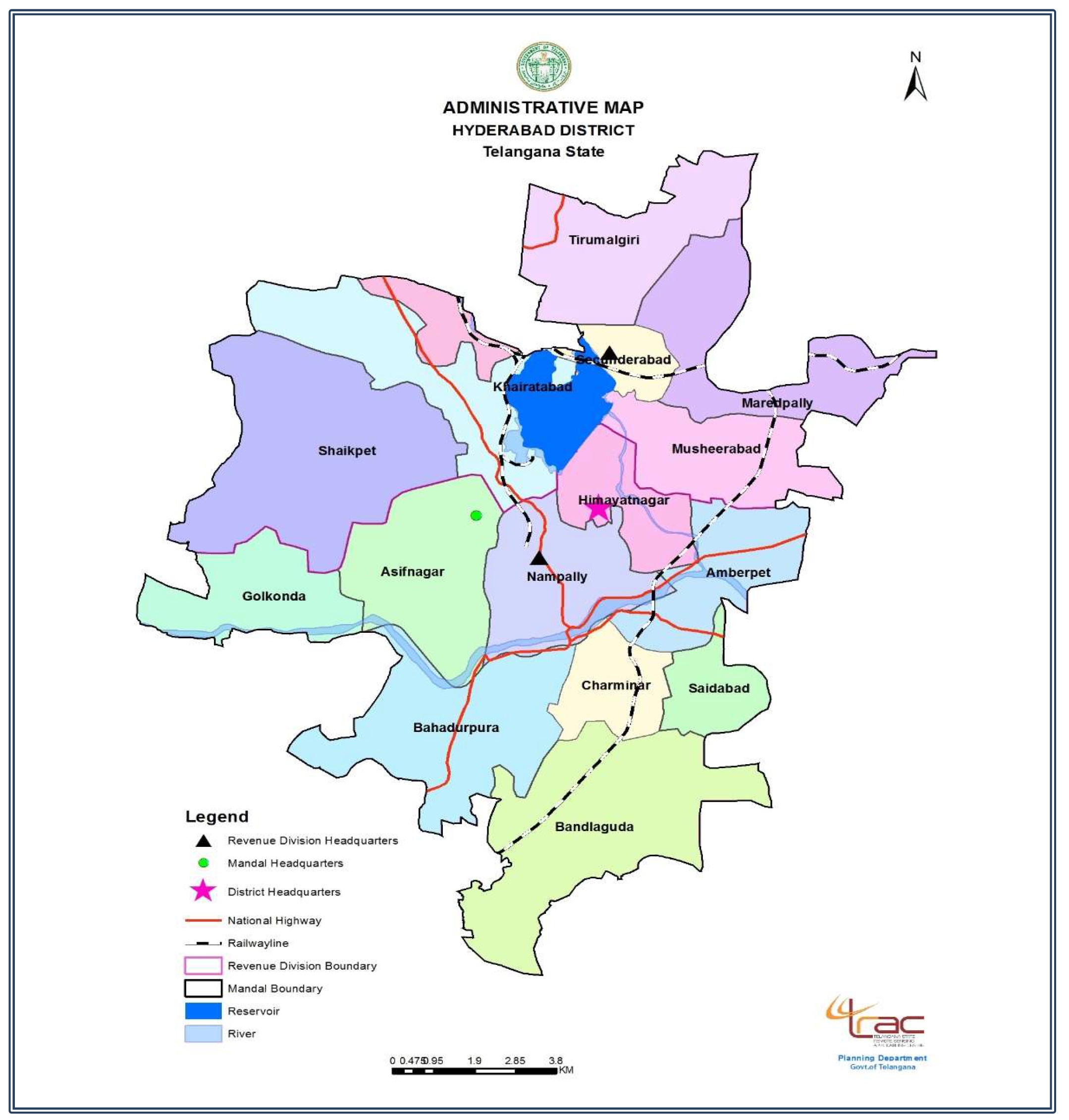
Hyderabad is a city-district in the state of Telangana and serves as the capital of the state. The district is known for its historic heritage, dense urban development, cultural diversity, educational institutions, technology sector and major public institutions.
The present Hyderabad district emerged in its current urban form in August 1978 after the creation of Ranga Reddy district from the erstwhile Hyderabad district. The district today represents a highly urbanised part of the Hyderabad metropolitan region.
Urban & Town Information
Hyderabad is an entirely urban district with its population distributed among major statutory and census urban units.
GHMC
Greater Hyderabad Municipal Corporation area, including the Municipal Corporation and outgrowth, forms the principal urban population centre.
Secunderabad Cantonment
The Secunderabad Cantonment Board forms another major urban unit within the district.
Osmania University
Osmania University is classified as a Census Town in the 2011 Census and represents a distinct urban unit within the district.
Population Details
Population profile of Hyderabad District based on Census 2011 data.
Population Chart
Gender-wise population distribution based on Census 2011 figures.
Hyderabad District Population
Total population: 39,43,323
Measurements & Geography
Key geographical and physical measurements of Hyderabad District.
Hyderabad District Statistics
Administrative, demographic and institutional indicators of Hyderabad District.
History of Hyderabad District
From its historic origins to its present-day role as the capital of Telangana.
A District Shaped by History
Hyderabad has a long and distinctive history. The city was founded in 1591 and was planned around the Charminar. Over time, the historic city expanded beyond the original walled settlement and developed into a large metropolitan centre.
Hyderabad has been associated with the historic Deccan region and is recognised for its architectural heritage, including Charminar, Golconda Fort, Mecca Masjid, Qutb Shahi Tombs and Paigah Tombs.
Hyderabad district was initially formed in 1948 after the Police Action through the merger of the Atraf-a-Balda and Baghat districts. In August 1978, the erstwhile Hyderabad district was reorganised following the creation of Ranga Reddy district. The present Hyderabad Urban District represents the highly urbanised core of the metropolitan region.